
Healthcare facilities, laboratories, manufacturing operations, cleanrooms, and technical work areas place demands on seating that extend beyond those of a traditional office. Employees may work at elevated surfaces, move frequently between tasks, spend hours performing detailed work, or operate in environments with specific material and electrostatic requirements.
BodyBilt offers healthcare and industrial chairs and stools designed around these specialized applications. Available configurations provide adjustability, durable construction, different seat heights, foot support, and seating options suited to a variety of technical work environments.
Certain BodyBilt seating can also be configured for cleanroom or electrostatic discharge applications when appropriate specifications are required. Because requirements vary significantly by facility, application-specific compatibility should always be confirmed before ordering.
Explore the featured healthcare and industrial seating below or contact a BodyBilt sales representative for help selecting a configuration for your workplace.
See Our Featured Healthcare and Industrial Seating
Healthcare Seating for Clinical and Support Environments
Healthcare seating needs vary considerably within the same facility. A clinical workstation, administrative area, dental environment, laboratory, and technical workspace can each require a different combination of materials, mobility, adjustability, and seat height.
One important consideration is cleanability. Chairs used in healthcare environments may be exposed to more frequent cleaning than conventional office seating. Materials and upholstery should therefore be selected based on the cleaning procedures and products used by the individual facility.
BodyBilt offers seating configurations with materials intended for applications where routine cleaning is important. Instead of treating seating as “germ-proof,” the better objective is to select surfaces and materials that support the organization’s established workplace hygiene procedures.
Facilities should always confirm that the selected upholstery and components are compatible with their approved cleaning products and protocols.
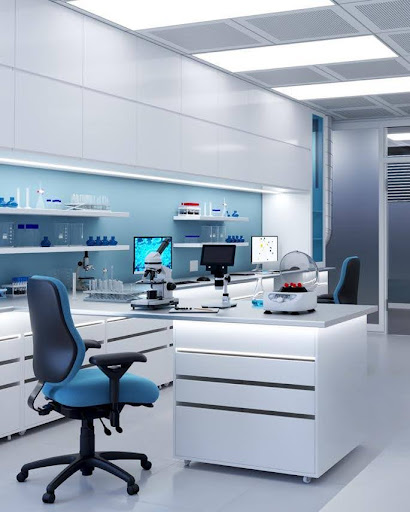
Laboratory Chairs and Lab Stools
Laboratory seating needs to accommodate the task as well as the person performing it. A technician working at a microscope may require a different seat height and working position from someone performing computer-based analysis or working at an elevated laboratory bench.
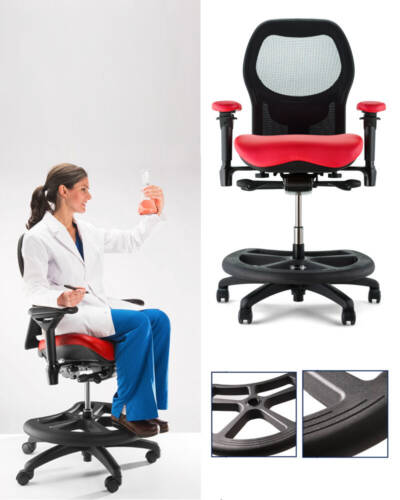
BodyBilt offers laboratory and specialized seating in both chair and stool configurations. Adjustable height, supportive seating, mobility, and available foot support can help users position themselves appropriately for the work surface.
A lab stool may be preferable when the work surface is higher or the user needs greater freedom of movement. A chair with a backrest may make more sense for tasks involving longer periods of seated work.
The right choice depends on bench height, task requirements, required mobility, available leg clearance, and how long employees typically remain seated.
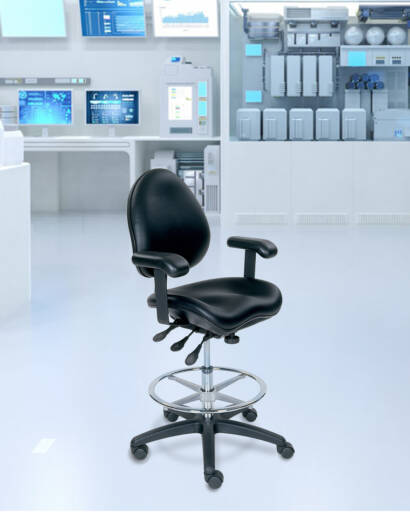
Cleanroom Seating for Controlled Environments
Cleanrooms require careful control over equipment and materials brought into the space. Seating should therefore be selected according to the requirements of the specific controlled environment rather than assuming that any industrial chair is appropriate.
BodyBilt offers cleanroom and ESD seating configurations for qualifying applications. Depending on the materials and configuration selected, BodyBilt documents seating options designed for Class 1, Class 10, and Class 100 cleanroom applications.
Cleanroom requirements can vary according to industry, facility, process, and applicable standards. Pharmaceuticals, biotechnology, semiconductor production, aerospace, medical device manufacturing, and other controlled environments can have very different specifications.
Before ordering cleanroom chairs or stools, confirm the required classification and environmental specifications with your facility manager, EHS team, cleanroom specialist, or other qualified personnel. BodyBilt can then help determine which available seating configuration aligns with those requirements.
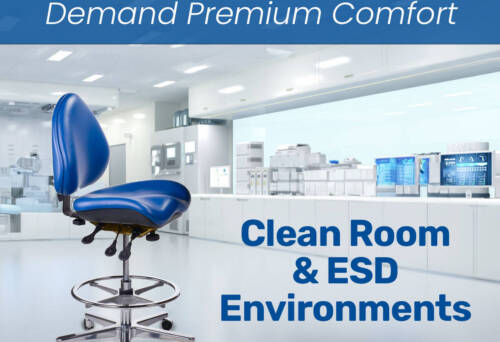
ESD Chairs for Electronics and Technical Work
Electrostatic discharge can present a significant concern in environments where employees work with sensitive electronic components.
For qualifying ESD configurations, BodyBilt uses static-dissipative materials and grounding components designed to help manage electrostatic charge. BodyBilt’s documented ESD construction includes dissipative fabric, specialized casters, grounding through the chair, and resistors incorporated into the seating system. Each configured ESD chair is tested before approval for its intended ESD application.
These configurations can be relevant to semiconductor manufacturing, electronics assembly, testing environments, technical laboratories, and other work areas where electrostatic discharge needs to be controlled.
ESD requirements should be determined by the facility before seating is selected. A chair should be treated as one component within a larger ESD-control program, not as a replacement for the facility’s grounding procedures, flooring, personal protective equipment, or other controls.
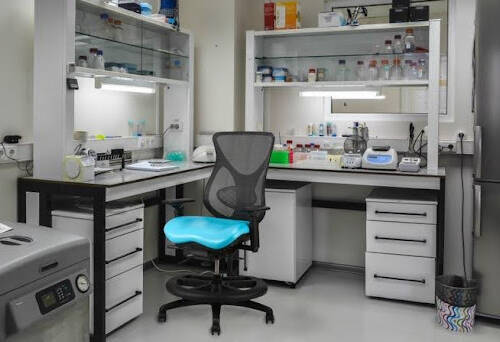
Industrial Seating for Manufacturing Environments
Manufacturing employees may work at assembly stations, inspection areas, technical benches, production equipment, computer terminals, or elevated surfaces. Their seating needs can change substantially from one station to another.
Industrial chairs and stools should be selected around the actual task. Seat-height range is especially important because many manufacturing work surfaces do not sit at standard desk height. Employees may also need enough mobility to move between nearby tools, components, and equipment without repeatedly standing.
Durable components matter in busy work areas, but adjustability should not be overlooked. Seat height, back support, foot support, and arm configuration can all influence how effectively an employee can position themselves relative to the task.
For facilities operating multiple shifts or requiring seating for extended use, BodyBilt’s intensive-use seating provides another option for applications where chairs face greater daily use.
Seating for Technical Work Areas
Technical environments often combine characteristics of offices, laboratories, and manufacturing spaces.
Engineers, technicians, quality-control personnel, electronics professionals, and other specialists may move between computer work, inspection tasks, equipment operation, and hands-on technical activities during the same shift.
A highly adjustable chair or workstool can give these employees more flexibility than seating designed around a single fixed task.
Important considerations can include:
- Seat-height range
- Seat size and contour
- Back support
- Foot rings or other foot support
- Adjustable arm options
- Caster and mobility requirements
- Upholstery and material selection
- Work surface height
- Cleanroom or ESD requirements, where applicable
The workstation should be evaluated as a system. The employee, work surface, tools, equipment, seating, and required movements all influence the appropriate configuration.
Chair or Stool: Which Is Better for Your Workspace?
The answer depends primarily on the work surface and task.
Traditional chairs are generally well suited to desk-height work and applications where users benefit from consistent back support. Workstools can provide additional height for laboratory benches, manufacturing stations, counters, and other elevated surfaces.
Foot support becomes especially important at elevated seating heights. A foot ring or other stable support surface can give users a place to position their feet when the floor is no longer comfortably accessible.
Mobility also deserves consideration. Casters may be useful when employees regularly move between nearby tasks, while some applications may require a more stable configuration.
Do not choose between a chair and stool based on the job title alone. Measure the work surface, look at how the employee performs the task, and consider the amount of movement required throughout a normal shift.
Healthcare and Industrial Seating Selection Guide
| Workplace | Important Seating Features | Common Seating Type | Additional Considerations |
| Healthcare Facilities | Adjustable support, appropriate upholstery, mobility, cleanable surfaces | Chair or stool | Confirm material compatibility with facility cleaning procedures |
| Laboratories | Appropriate seat-height range, foot support, adjustability, mobility | Lab chair or lab stool | Match seating height to bench and task |
| Cleanrooms | Application-appropriate materials and documented cleanroom configuration | Cleanroom chair or stool | Confirm required cleanroom classification before ordering |
| Electronics & ESD Areas | Static-dissipative configuration and grounding components | ESD chair or stool | Verify facility ESD requirements and applicable specifications |
| Manufacturing | Durable components, mobility, adjustable height, appropriate foot support | Industrial chair or workstool | Evaluate workstation height and employee movement |
| Technical Work Areas | Adjustability, mobility, seat-height range and task-specific support | Chair or stool | Consider computer work, equipment access and hands-on tasks together |
What to Check Before Ordering Healthcare or Industrial Seating
Specialized seating should be selected based on documented workplace requirements rather than appearance alone.
Before choosing a chair or stool, identify:
Work surface height: Measure the desk, bench, counter, or workstation so the required seat-height range can be determined.
Task requirements: Look at how the employee actually works. Consider reaching, leaning, equipment use, computer work, inspection tasks, and movement between stations.
Foot support: Elevated seating may require a foot ring or another appropriate support surface.
Mobility: Determine whether employees need to move between nearby tasks while seated and whether the intended caster configuration suits the work area.
Arm requirements: Arms can provide useful support for some tasks but may interfere with benches, equipment, or frequent movement in others.
Cleaning procedures: Healthcare and laboratory facilities should confirm that the selected seating materials are compatible with their established cleaning agents and protocols.
Environmental requirements: Cleanroom classification and ESD specifications should be established before selecting a specialized configuration.
BodyBilt’s product documents and specifications can provide additional information when evaluating seating options.
Why BodyBilt for Specialized Workplace Seating?
Specialized environments need seating selected around the work rather than a generic office configuration.
BodyBilt designs chairs and lab stools with an emphasis on adjustability, anatomical support, workplace comfort, and application-specific configuration. Available seating spans standard office environments, healthcare and laboratory applications, technical workplaces, industrial settings, and qualifying cleanroom and ESD applications.
Organizations can also work directly with BodyBilt to determine which seating features make sense for a particular environment instead of trying to select a specialized chair based solely on a product image or model name.
That approach can be especially useful when furnishing multiple work areas with different bench heights, environmental requirements, employee needs, or shift patterns.
Find the Right Seating for Your Healthcare, Lab or Industrial Facility
Selecting specialized seating starts with understanding the environment. BodyBilt can help your team evaluate work surface height, chair or stool requirements, adjustability, material considerations, ESD needs, cleanroom requirements, and other application-specific factors.
Talk to a BodyBilt Sales Representative About Specialized Seating
FAQ
A lab chair typically provides a seated configuration with back support for desk or workstation tasks, while a lab stool can accommodate elevated benches and work surfaces. The better choice depends on work surface height, task requirements, foot support, and how employees move while working.
Look at seat-height requirements, adjustability, mobility, upholstery, cleaning needs, arm options, and the tasks employees perform. Materials should also be checked against the healthcare facility’s approved cleaning procedures before a chair or stool is selected.
An ESD chair is configured to help manage electrostatic charge in environments where static discharge can affect sensitive equipment or components. BodyBilt offers qualifying ESD configurations that incorporate static-dissipative materials and grounding components, but the appropriate specifications should be confirmed for the facility before ordering.
BodyBilt offers seating configurations intended for qualifying cleanroom applications, including documented options for Class 1, Class 10, and Class 100 environments depending on the selected materials and configuration. Buyers should confirm their facility’s required classification and specifications before selecting cleanroom seating.
Start with the work surface height and the tasks performed at the station. Then consider required seat-height range, foot support, mobility, arm options, durability, employee adjustment needs, and any environmental requirements. A BodyBilt representative can help match those requirements to an appropriate chair or stool configuration.